

How to Get from Zurich Airport to the City Centre (2026 Guide)
21 June 2026
Disclaimer: All prices, schedules and service details in this article reflect information available in June 2026. Transport fares and timetables change regularly — always verify the latest information on the official websites of each provider before you travel. The author and Faretus accept no liability for any inaccuracies, changes, or decisions made based on this content.
Zurich Airport (ZRH) sits about 12 kilometres north of the city centre in Kloten — and it contains one of the most quietly impressive airport train stations in Europe. The underground SBB station sits directly beneath the terminal, trains run to Zurich Hauptbahnhof every few minutes, and the journey takes about ten minutes. For most travellers the decision is functionally made the moment they clear customs: follow the signs to the train, buy a CHF 6.80 ticket, and you're done.
What makes Zurich slightly more interesting to navigate than it first appears is the zone system, the existence of a perfectly pleasant alternative by tram, the fact that Swiss taxis are metered and expensive in a way that surprises people who haven't checked in advance, and a few small details about the ZVV ticket structure that are worth knowing before you stand at a machine. None of it is complicated. But arriving informed saves time and money in a city where both have a price.
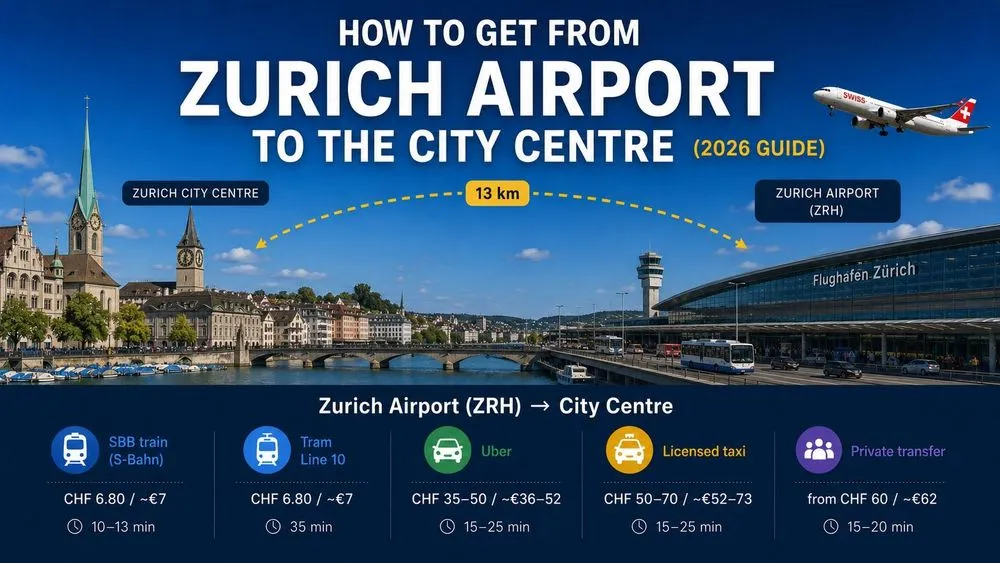
There are five realistic options for the journey. All of them are below.
One important note: Switzerland is not a cheap-taxi country
Zurich taxis operate on a regulated meter: a base fare of around CHF 6, then approximately CHF 3.80 per kilometre during the day, rising to a higher tariff after 23:00 and on Sundays. A ride to the city centre from the airport will cost CHF 50–70 in normal daytime traffic. That is not a scam — it is the standard regulated rate, and it reflects the fact that Zurich is consistently one of the most expensive cities in the world. If you're arriving expecting Bolt at €12, adjust before you land.
The quick comparison
| Option | Price (one-way) | Time to centre | Frequency | Best for |
|---|---|---|---|---|
| SBB train (S-Bahn) | CHF 6.80 / ~€7 | 10–13 min | Every 5–10 min | Almost everyone |
| Tram Line 10 | CHF 6.80 / ~€7 | 35 min | Every 8–15 min | Scenic arrivals, no rush |
| Uber | CHF 35–50 / ~€36–52 | 15–25 min | On demand | App users, light luggage |
| Licensed taxi | CHF 50–70 / ~€52–73 | 15–25 min | On demand | Groups, late arrivals |
| Private transfer | from CHF 60 / ~€62 | 15–20 min | Pre-booked | Families, business travel |
Option 1 — SBB train: the obvious correct answer for most people
The SBB underground station is directly beneath Airport Center, the main terminal building. Follow the signs from the arrivals hall — it takes about three minutes on foot — and you'll find yourself in a clean, modern underground station with departures in several directions. For the city centre, you want Zurich Hauptbahnhof (Zürich HB): the journey takes 10–13 minutes and trains run every 5–10 minutes throughout the day.
The fare is CHF 6.80 for a single adult ticket covering ZVV zones 121 (airport) and 110 (City of Zurich). Zone 110 is a double zone by ZVV convention, which is why the price is slightly higher than a standard two-zone ticket — the system counts it as three zones. Children aged 6–16 pay half. Under-6s travel free. Buy at the SBB machines in the arrivals hall or underground station — they accept cards and offer an English interface. There is no on-board purchase; buy before you board.
At Zürich HB, you arrive at the largest and busiest rail terminus in Switzerland, with trams, buses, the Polybahn funicular, and connections to every part of the country right outside the doors. For most destinations in the city, it's within walking distance or one tram stop.
One note for 2026: SBB construction work on the double-track expansion between Zurich Oerlikon and Bassersdorf is causing some diversions and timetable changes to regional services. Check the SBB app or website for current departure times before you travel — the airport train is frequent enough that any disruption is manageable, but it's worth being aware.
If you hold a Swiss Travel Pass: the Swiss Travel Pass covers the airport train to Zurich HB, so activating it before boarding saves you buying a separate ticket. Activate at the SBB desk in the airport station or digitally via the SBB app before boarding. Make sure your activation date is correct — starting it on a day when you only have a short transfer to your hotel may waste a travel day.
If you're staying in Zurich for two or more days: the ZVV day pass for zones 110 and 121 costs CHF 16 per adult and covers all public transport — train, tram, bus, even the Limmat river boats and the Polybahn funicular — for a full calendar day. For a visitor using the train from the airport plus a few tram rides in the city, it pays for itself by mid-afternoon.
The honest take: The SBB train is the best airport transfer in this series of guides. It is faster than Vienna's CAT, cheaper than Copenhagen's metro per relative city cost, and the station is literally inside the building. For a solo traveller or a pair with manageable luggage, there is no meaningful argument for anything else.
Option 2 — Tram Line 10: slower, prettier, same price
Tram Line 10 departs from directly outside the arrivals hall — exit and turn right, and the stop is immediately in front of you. It runs to Zürich HB/Bahnhofplatz in about 35 minutes, passing through northern Zurich suburbs including Glattbrugg, Oerlikon, and Milchbuck before reaching the city centre. The fare is the same CHF 6.80 as the train, and the tram runs every 8–15 minutes throughout the day.
The tram does not stop inside the terminal or require descending underground. You board outdoors, the ride is at ground level with windows, and you see the city gradually appear around you rather than emerging from a tunnel directly at the main station. It is objectively the more pleasant way to arrive if you're not in a hurry.
After 01:00, regular trams stop and a night network takes over. The airport is served by night buses on this period — check ZVV or the SBB app for the specific service running at your arrival time, as late-night options are less frequent than the daytime tram.
The honest take: The tram makes sense when you want a gentler start, you're not carrying heavy bags, and your hotel is somewhere along the Line 10 route rather than at the Hauptbahnhof end. It makes no financial sense over the train — the price is identical — but the experience is different enough that it's worth knowing about. If you have significant luggage, the train is significantly easier.
Option 3 — Uber: faster than the tram, cheaper than a taxi
Uber operates at ZRH with a designated pickup zone outside the arrivals area. During normal hours, an UberX to central Zurich costs approximately CHF 35–50 and takes 15–25 minutes by car. That makes it meaningfully cheaper than a metered taxi for equivalent journeys, and the fixed price shown upfront before you confirm is a genuine advantage in a city where taxi meters can be alarming to first-time visitors.
During peak hours, however, Uber prices surge. On a busy Friday evening or during a major event, the same ride can reach CHF 60–70 — at which point the advantage over a taxi disappears. Check the app the moment you clear customs; if the quote is reasonable, take it.
The honest take: For two people travelling together where the train feels inconvenient — heavy luggage, awkward hotel location, arrived tired — Uber at CHF 40 split two ways is CHF 20 each. That's still three times the train, but it's not outrageous in Zurich context. For one person, the CHF 30+ premium over the train is a lot for a ten-minute journey that the train already does perfectly.
Option 4 — Licensed taxi: reliable, regulated, expensive
Zurich's taxi market is licensed and metered. Taxi ranks are located outside Arrivals 1 and 2 — turn right as you exit. All licensed taxis carry an illuminated sign and run a calibrated taximeter; Tariff 1 applies during the day, Tariff 2 after 23:00 and on Sundays. A typical daytime ride to the city centre costs CHF 50–70 and takes 15–25 minutes. Night fares are higher.
Many operators will agree to a fixed price if your destination is well-known (such as Zürich HB or a major hotel on Bahnhofstrasse). It's worth asking — a fixed quote protects you from traffic delays during peak hours. As with every airport in this series: ignore anyone approaching you inside the terminal offering a ride. Use the official rank outside.
The honest take: For a single traveller the taxi is hard to justify when the train does the same journey for CHF 6.80. For two or three people splitting a CHF 60 fare, it's CHF 20–30 each — still expensive relative to the train, but tolerable for the door-to-door convenience. For a group of four, it becomes competitive with individual train tickets while delivering everyone to their hotel directly.
Option 5 — Private transfer: certainty at a fixed price
Pre-booked private transfers meet you in the arrivals hall with a name sign, track your flight, and hold a fixed price regardless of traffic. Prices for a standard sedan start at around CHF 60–70 to the city centre; larger vehicles for families or groups run higher. Several operators are available online; book before you fly.
The private transfer earns its place on the list primarily for business travellers on tight schedules, families with young children, and anyone arriving very late who doesn't want to figure out night bus logistics. For a family of four, CHF 70 split four ways is CHF 17.50 per person — not far from what four individual train tickets would cost, with the addition of door-to-door service and someone carrying your luggage.
The honest take: The train is so fast and so easy at ZRH that the private transfer has a narrower use case here than at most airports. Unless you have a specific reason — late arrival, children, a hotel that's genuinely difficult to reach by public transport — the train is the right answer.
Which option is right for you?
- Solo traveller, any luggage, daytime arrival → SBB train. CHF 6.80, ten minutes, done. There is no better deal in Swiss public transport.
- Travelling with a Swiss Travel Pass → SBB train at no extra cost. Activate at the desk in the station before boarding.
- Staying 2+ days in Zurich → Buy the ZVV day pass at CHF 16 on arrival. It covers the airport and all city transport for the day.
- Want a scenic arrival without rushing → Tram Line 10. Same price as the train, thirty-five minutes instead of ten, completely pleasant.
- Two people, heavy luggage → Check Uber first. Under CHF 40, it's worth splitting. Above CHF 50, take the train and manage the bags — the platforms at Zürich HB have lifts and trolleys.
- Group of three or four → Taxi or private transfer. At CHF 60 split four ways, it's CHF 15 per person with door-to-door service.
- Arriving late at night → Train is the safest bet; S-Bahn services run regularly until around 01:00, with reduced frequency after that. Check the ZVV night network for your specific arrival time.
- Continuing directly to another Swiss city → Take the SBB train from the airport station directly. Zurich Airport has direct intercity connections to Basel (approx. 60 min), Bern (approx. 75 min), and Lucerne (approx. 70 min), bypassing Zürich HB entirely.
The detail that makes ZRH different
Most airport transfer guides in this series come down to a trade-off: speed versus cost versus convenience. Zurich is unusual because the fastest option is also the cheapest, and the station is inside the terminal building. There is no equivalent calculation to make.
The only real decision is whether you need door-to-door service — and in a city as walkable and tram-dense as Zurich, most visitors find that Zürich HB is close enough to almost everywhere that matters that it barely qualifies as a connection.
Switzerland charges accordingly for almost everything. The airport train is one of the few things here that costs less than you'd expect.
And if you haven't found the flight to get you there yet, the Faretus deals page is where to look.
All information in this article is based on publicly available data from official transport providers as of June 2026. Prices, schedules and service arrangements may change without notice. Always verify directly with the relevant provider — SBB (sbb.ch), ZVV (zvv.ch), or your taxi or transfer provider — before travelling. The author and Faretus bear no responsibility for any decisions made based on the content of this article.