



How to get from Suvarnabhumi Airport to Bangkok City Centre (2026 Guide)
5 July 2026
Disclaimer: All prices, schedules and service details in this article reflect information available in July 2026. Transport fares and timetables change regularly — always verify the latest information on the official websites of each provider before you travel. The author and Faretus accept no liability for any inaccuracies, changes, or decisions made based on this content.
Suvarnabhumi Airport (BKK) sits about 30 kilometres east of central Bangkok, and getting from one to the other involves a decision that mostly comes down to one question: is the Airport Rail Link running when you land? If yes, it's the easy answer. If no — because you've arrived after midnight, which happens to a lot of long-haul arrivals into Bangkok — you're looking at taxis and ride-hailing apps instead, and there's a specific right way to do that too.
One housekeeping note before anything else: Bangkok has two airports. Suvarnabhumi (BKK) is the larger international hub, used by most full-service carriers — Thai Airways, Singapore Airlines, Emirates, Qatar Airways, Cathay Pacific, and most long-haul flights. Don Mueang (DMK) is the older, secondary airport, used mostly by AirAsia, Nok Air, and other low-cost domestic and regional carriers. This article is about Suvarnabhumi. If you landed somewhere smaller and further from a modern terminal, check your boarding pass — you may be at DMK, where the transport situation is different.
The quick comparison
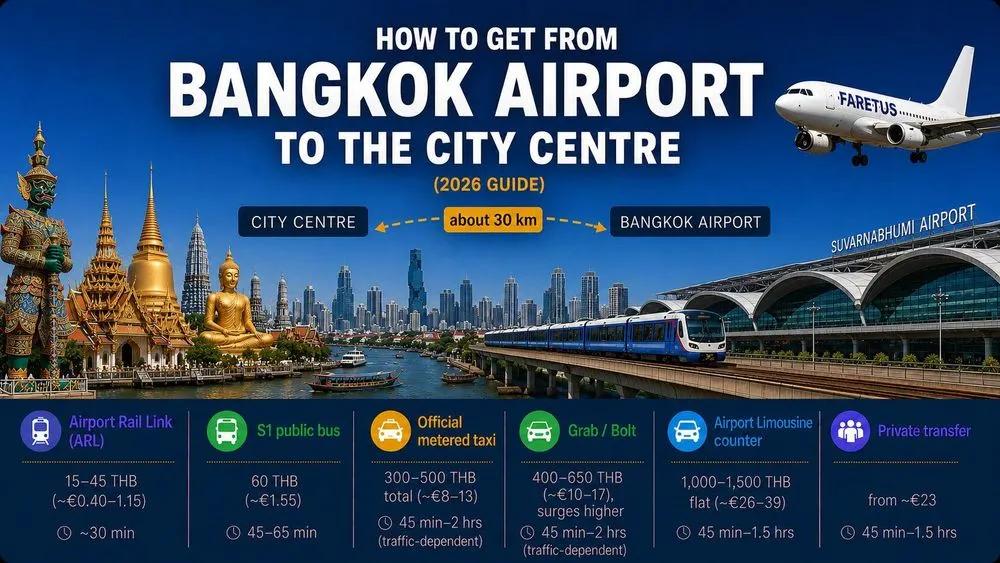
| Option | Price (one-way) | Time to centre | Hours | Best for |
|---|---|---|---|---|
| Airport Rail Link (ARL) | 15–45 THB (~€0.40–1.15) | ~30 min | 05:10–00:00 | Almost everyone, daytime |
| S1 public bus | 60 THB (~€1.55) | 45–65 min | ~06:00–21:00 | Very tight budgets |
| Official metered taxi | 300–500 THB total (~€8–13) | 45 min–2 hrs (traffic-dependent) | 24 hours | Groups, luggage, night arrivals |
| Grab / Bolt | 400–650 THB (~€10–17), surges higher | 45 min–2 hrs | 24 hours (thin 01:00–04:00) | Most solo/duo travellers |
| Airport Limousine counter | 1,000–1,500 THB flat (~€26–39) | 45 min–1.5 hrs | 24 hours | Zero-negotiation certainty |
| Private transfer | from ~€23 | 45 min–1.5 hrs | Pre-booked | Families, night arrivals |
⚠️ The Airport Rail Link stops running at midnight. If your flight lands after that, your only options are road-based: official taxi, Grab, Bolt, the Limousine counter, or a pre-booked transfer. Between roughly 01:00 and 04:00, ride-hailing apps can be genuinely difficult to get a driver on — the official taxi rank, which operates 24 hours, is the more reliable choice at that hour.
Option 1 — Airport Rail Link (ARL): fast, cheap, and the default choice
The Airport Rail Link is an elevated train connecting Suvarnabhumi directly to central Bangkok along an 8-station line. The station is on the basement level (B floor) of the terminal — follow the ARL signs from the arrivals hall down to the platform. Look also for "Train to City" signage, used interchangeably with "Airport Rail Link" throughout the terminal.
Fares are distance-based, from 15 THB for the shortest hop up to 45 THB for the full run to Phaya Thai — roughly €0.40 to €1.15. The two most useful fares for visitors: 35 THB to Makkasan Station (interchange with the MRT subway) or 45 THB to Phaya Thai Station (interchange with the BTS Skytrain). Children under 90cm tall travel free. The full journey takes around 30 minutes.
Trains run from 05:10 to midnight, seven days a week, departing every 9–10 minutes during rush hour (roughly 06:00–09:00 and 16:00–20:00) and every 12–15 minutes off-peak. Tickets are sold as tokens from vending machines (English-language option available, cash accepted). As of November 2025, you can also tap a contactless Visa, Mastercard, JCB, or UnionPay card directly on the fare gates — no need to queue at the machine at all if your card supports it.
The real value of the ARL is its connections. At Makkasan, walk through to Phetchaburi MRT station and continue on the subway. At Phaya Thai, you connect directly to the BTS Skytrain Sukhumvit Line — the fastest way to reach popular areas like Asok, Nana, Phrom Phong, and Thong Lo. If you're staying in Sukhumvit, the ARL-to-BTS combination (roughly 45–90 THB total) is genuinely the fastest and most cost-effective way into that part of the city, often faster than a taxi during peak traffic.
The honest take: For solo and duo travellers arriving between 05:10 and midnight, the ARL combined with a BTS or MRT transfer is close to unbeatable — cheap, air-conditioned, tap-to-pay, and completely unaffected by Bangkok's traffic. The one real downside: during peak commuting hours the train gets genuinely crowded, and it's not an easy option if you're travelling with multiple large suitcases — consider using an airport luggage storage service if you want to travel light on the train.
Option 2 — S1 public bus: the cheapest option, aimed at backpackers
The S1 bus, operated by BMTA, runs from the airport directly to Khao San Road, Bangkok's well-known backpacker district, with several stops along the way. The fare is a flat 60 THB (~€1.55), paid in cash to the conductor on board — carry small notes, as drivers can't always break large ones.
The bus stop is on Level 1 (Gate 7) of the terminal. Buses run every 30 minutes, generally from around 06:00 to 21:00 heading into the city. Journey time is 45–65 minutes, longer during traffic.
The honest take: If Khao San Road is your destination and you're travelling light with time to spare, this is the cheapest way to get there. For most other destinations in the city, the extra complexity of connecting onward from Khao San outweighs the savings versus the ARL.
Option 3 — Official metered taxi: reliable, if you know the real total cost
Suvarnabhumi has one of the better-organised official taxi systems of any major Asian airport, but the total cost has more moving parts than people expect. On Level 1, follow signs for "Public Taxi" or "Taxi Meter" — do not go with anyone who approaches you inside the arrivals hall or just outside the doors, as these are unlicensed touts charging 3–5 times the metered rate.
At the official rank, there's an automated ticket dispenser: take a numbered ticket, wait for it to be called, and you'll be directed to your assigned lane and cab. The driver is required to use the meter and cannot refuse the fare or insist on a fixed price higher than the meter reading.
Here's what the total actually adds up to. The meter itself typically reads THB 250–400 to central Bangkok. On top of that: a THB 50 airport surcharge, added automatically and non-negotiable, and expressway tolls of roughly THB 40–110, paid in cash directly to the driver at the toll booths (Motorway 7 into the city typically has 2–3 booths). All in, the realistic total is THB 350–550, occasionally higher in heavy traffic or on longer routes — roughly €9–15. Journey time ranges from 45 minutes in light traffic to well over 90 minutes during peak hours (07:00–09:30 and 17:00–19:30), when Bangkok's traffic can be genuinely severe.
One more practical detail: the queue at the taxi rank itself can run 20–45 minutes during busy periods — Friday and Sunday evenings, and the December holiday season, are the worst times. Have small notes ready for the surcharge and tolls; many drivers can't break large bills, and airport ATMs charge roughly THB 220 per international withdrawal.
The honest take: For two or more people, or anyone with substantial luggage, the official taxi queue is a safe and reasonably priced option once you budget for the surcharge and tolls on top of the metered number you see quoted online. It's also the only rail-free option that operates a full 24 hours with consistent availability — genuinely useful for late-night or very early arrivals, when the queue is also much shorter.
Option 4 — Grab and Bolt: convenient, but check the price before committing
Grab is the dominant ride-hailing app across Southeast Asia and operates extensively at Suvarnabhumi. Bolt has a growing presence in Bangkok too. Both show a price before you confirm, which removes the queue and negotiation entirely.
Typical fares to central Bangkok run THB 400–600 during normal conditions — broadly comparable to, sometimes slightly above, the all-in metered taxi total once tolls and surcharge are included. Note that the price shown in the app usually does not include the expressway toll, which you pay in cash to the driver separately, typically an additional THB 25–75 depending on vehicle size. During surge periods — Friday and Sunday evenings especially — prices can jump to THB 500–1,200 or more.
The pickup point is a designated rideshare zone — the app directs you to the specific exit gate and level. Baggage trolleys must stay inside the terminal; you'll need to carry your own bags to the pickup point.
One important limitation: between roughly 01:00 and 04:00, driver availability drops significantly, and it can take a long time to get matched — sometimes long enough that the official 24-hour taxi rank is the more practical choice at that hour.
The honest take: Grab is convenient and avoids the taxi queue, but it isn't reliably cheaper than a metered taxi once you account for the toll paid separately, and during surge windows it can be considerably more expensive. Check the quoted price against the roughly THB 350–550 all-in taxi total before committing, particularly on Friday or Sunday evenings.
Option 5 — Airport Limousine counter: flat price, zero negotiation
Less well known to first-time visitors: Suvarnabhumi has an official Limousine counter (look for it near Gates 4–8 in arrivals) offering a flat, published fare — typically THB 1,000–1,500 — to central Bangkok addresses, with no meter, no surge, no separate toll charge, and no surcharge on top. Vehicles are standard sedans, usually a Toyota Camry or similar.
The honest take: This sits between a metered taxi and a pre-booked private transfer in both price and certainty. If you didn't pre-book anything and want to skip the queue, the negotiation, and the toll cash-handling entirely, it's a reasonable middle option — you'll pay roughly double a metered taxi's all-in cost, but you know the exact number before you get in the car.
Option 6 — Private transfer: worth it for late arrivals and families
Pre-booked private transfers meet you in the arrivals hall with a name sign, track your flight for delays, and take you directly to your hotel at a fixed price, typically starting around €23 for a standard sedan, with premium options (larger vehicles, flight-tracking, free wait windows) priced higher. Given the language considerations, unfamiliar currency, and general disorientation of a long-haul arrival, this option removes several friction points at once.
The honest take: Particularly worth considering for first-time visitors to Thailand, families with children, or anyone landing in the small hours of the morning when other options are less predictable or more expensive.
Which option is right for you?
- Arriving between 05:10 and midnight, heading to Sukhumvit, Silom, or Siam → ARL to Phaya Thai or Makkasan, then BTS/MRT. Fast, cheap, avoids traffic entirely.
- Heading to Khao San Road, travelling light and on a tight budget → S1 bus. 60 THB, direct.
- Arriving after midnight → Official taxi rank (24 hours, shorter queue at that time) or pre-booked private transfer. The ARL is closed.
- Two or more people, or significant luggage → Official metered taxi. Budget THB 350–550 all-in once surcharge and tolls are included.
- Want zero queue and zero negotiation, didn't pre-book → Airport Limousine counter. Flat THB 1,000–1,500, no surprises.
- Solo or duo, comfortable with an app → Grab, but check the quoted price against the taxi total, especially on Friday/Sunday evenings when surge pricing kicks in.
- First time in Thailand, want zero friction after a long flight → Pre-booked private transfer.
- Travelling during Bangkok rush hour (07:00–09:30, 17:00–19:30) → ARL if it fits your route. Road transport can take 90 minutes to 2 hours during these windows.
Things people get wrong at Suvarnabhumi Airport
Accepting a taxi from someone inside or just outside the terminal. This is the single biggest scam risk at BKK — unlicensed touts charge 3–5 times the metered rate. The official queue, with its numbered ticket system, is the only place to get into a taxi from the airport.
Assuming the Grab quote is the final price. The app fare typically doesn't include the expressway toll, which you pay separately in cash to the driver. Factor in an extra THB 25–75 when comparing Grab against a metered taxi.
Not budgeting for the surcharge and tolls on top of the meter. A metered fare of THB 300 can become a THB 400–450 total once the THB 50 airport surcharge and toll charges are added. This catches people who only checked the "metered fare" figure online rather than the realistic all-in cost.
Assuming Grab or Bolt will be instantly available at 2am. Ride-hailing apps in Bangkok can have genuinely thin driver coverage between roughly 01:00 and 04:00. If your flight lands in that window, check the app's estimated wait time immediately, and don't hesitate to go straight to the 24-hour taxi rank if it looks slow.
Underestimating Bangkok traffic. The 30km road journey to central Bangkok can take anywhere from 45 minutes to over 2 hours, depending entirely on time of day and day of the week. If you have a tight connection or a scheduled meeting, build in serious buffer time, or take the ARL where your route allows — it isn't affected by road congestion.
Not carrying small Thai baht notes. Toll booths, the S1 bus conductor, and various drivers can't always break large notes. Exchange or withdraw cash in the arrivals hall before heading out, and keep small denominations on hand — airport ATMs charge roughly THB 220 per international withdrawal, so it's worth taking out a reasonably large amount at once rather than withdrawing repeatedly.
A note on Don Mueang (DMK)
If you're flying a budget airline into Bangkok — particularly AirAsia — double-check you're not actually landing at Don Mueang (DMK), Bangkok's secondary airport, roughly 25–30km north of the centre. DMK has its own separate taxi system (same metered-plus-surcharge structure, typically a slightly lower total of THB 300–400 given the shorter distance to many parts of the city), a different set of bus routes, and no direct rail link into the city — you'd need to connect via a shuttle bus to reach the ARL or BTS network. The two airports are entirely separate facilities, roughly 40km apart by road.
Final thought
Suvarnabhumi is a big, modern, well-organised airport, and Bangkok has built a genuinely solid transport system around it — provided you land at the right time of day and know the real cost of each option rather than just the headline figure. The ARL is the standout choice whenever it's running: cheap, fast, tap-to-pay, and completely indifferent to the gridlock outside. When it isn't running, the official taxi system is honest and well-regulated, provided you budget for the surcharge and tolls that sit on top of the meter.
Land, find the right platform or the right taxi lane, and you'll be in central Bangkok — eating something extraordinary from a street stall — well within the hour, traffic permitting.
And if you're still looking for the cheap flight to Bangkok, check the Faretus deals page. BKK is one of the best-connected long-haul hubs from Europe, and fare drops on this route come up more often than travellers expect.
All information in this article is based on publicly available data from official transport providers as of July 2026. Prices, schedules and service arrangements may change without notice. Always verify directly with the relevant provider — Airport Rail Link (bangkokairporttrain.com), BMTA (bmta.co.th), Suvarnabhumi Airport (suvarnabhumi.airportthai.co.th) — before travelling. The author and Faretus bear no responsibility for any decisions made based on the content of this article.