
How to Get from Oslo Airport Gardermoen to the City Centre (2026 Guide)
22 June 2026
Disclaimer: All prices, schedules and service details in this article reflect information available in June 2026. Transport fares and timetables change regularly — always verify the latest information on the official websites of each provider before you travel. The author and Faretus accept no liability for any inaccuracies, changes, or decisions made based on this content.
Oslo Airport (OSL), commonly known as Gardermoen, sits about 47 kilometres north of the city centre — one of the furthest airports from its capital in this guide series, on par with Munich. The distance shapes everything else: this is not a city where you wander out of arrivals and grab a cheap taxi. Norway is one of the most expensive countries in the world, and Oslo's airport transfer pricing reflects that honestly. A taxi will run you the equivalent of a nice dinner. A train ticket, while cheaper, is still not pocket change.
What Oslo gets right is the train infrastructure. Two separate train operators run from directly beneath the terminal into the city, at two very different price points for almost the same journey time. Picking the right one is the single biggest money-saving decision you'll make on this transfer — and it's a decision the airport's own signage actively pushes you away from.
There are five realistic options for the journey. All of them are below, with the trap explained clearly so you don't fall into it.
The one thing you need to know before anything else
Walking out of customs at OSL, the first and most prominent sign you'll see says Flytoget — Fastest way to Oslo city centre. It is technically true. It is also nearly double the price of an almost identical train running from the same station, four minutes slower, with no meaningful downside. Both trains are clean, comfortable, modern, and depart from the same underground platforms. The airport's own wayfinding is optimised to send you toward the more expensive option first. Read the next two sections before you buy anything.
The quick comparison
| Option | Price (one-way) | Time to centre | Frequency | Best for |
|---|---|---|---|---|
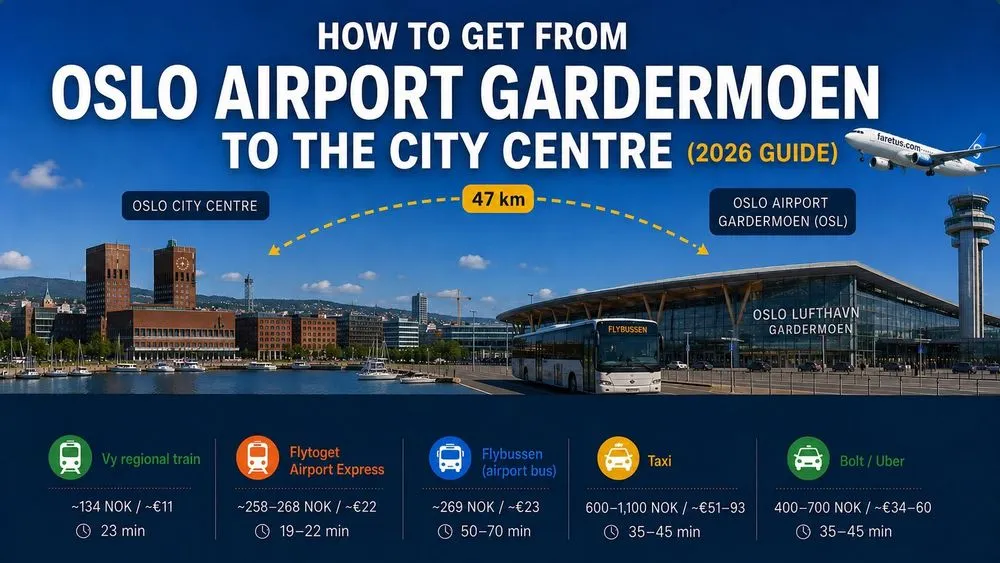
| Vy regional train | ~134 NOK / ~€11 | 23 min | Every 20–30 min | Almost everyone |
| Flytoget Airport Express | ~258–268 NOK / ~€22 | 19–22 min | Every 10 min | Speed, guaranteed seating, families |
| Flybussen (airport bus) | ~269 NOK / ~€23 | 50–70 min | Every 20–30 min | Specific city districts away from Oslo S |
| Taxi | 600–1,100 NOK / ~€51–93 | 35–45 min | On demand | Groups, late arrivals |
| Bolt / Uber | 400–700 NOK / ~€34–60 | 35–45 min | On demand | App users, lighter on the wallet than a taxi |
Option 1 — Vy regional train: the smart default
Vy (formerly NSB, Norway's national rail operator) runs a regional train through Oslo Airport station on its way south toward Oslo, Drammen and beyond. It departs from the same underground station as Flytoget, just a different platform — usually Platform 4. The journey to Oslo Sentralstasjon (Oslo S) takes about 23 minutes, only 4 minutes slower than the express service, and trains run every 20–30 minutes throughout the day, with more than 50 daily departures.
A standard adult ticket costs approximately 134 NOK (about €11) — roughly half the Flytoget fare for nearly the same journey. Children aged 6–17 and seniors over 67 pay half price; under-6s travel free. Buy at the Vy ticket machines in the arrivals hall (look for screens labelled "Billetter / Tickets," not the prominent Flytoget signage), via the Vy app, or online in advance. The ticket includes free transfers onto Oslo's buses, trams and T-bane metro for 2.5 hours after purchase, which is genuinely useful if your hotel isn't right at Oslo S.
One navigation note: at the platform, make sure you board a Vy train and not a Flytoget train running on an adjacent platform at a similar time — they look different (Vy trains carry red/grey livery; Flytoget trains are sleek and silver) but a moment of inattention while loaded down with luggage is an easy way to end up on the wrong service and the wrong fare.
The honest take: For the overwhelming majority of travellers, this is the correct choice. You save more than half the Flytoget price for a four-minute time difference. The trains can be busier at peak times since Vy also serves regular commuters passing through the airport, but the ride is short enough that standing for part of it is a minor inconvenience, not a real cost.
Option 2 — Flytoget Airport Express: faster, guaranteed seat, costs more
Flytoget is Oslo's dedicated airport express train, purpose-built for travellers rather than commuters. It runs every 10 minutes during the day (every 20 minutes late at night and early morning), and trains alternate between a genuinely express service (19 minutes to Oslo S) and a slightly slower one that calls at Lillestrøm (22 minutes). Both stop at Nationaltheatret, useful if your destination is in the western part of the centre.
A single adult ticket costs 258–268 NOK (about €22). Students, youth aged 16–20, and seniors over 67 pay half price with valid ID. Children under 16 travel completely free when accompanied by an adult, regardless of the adult's ticket type — this is the detail that changes the calculation for families (see below). Buy from the Flytoget app or vending machines; turn right after clearing customs and follow the signs.
Flytoget trains guarantee a seat, have generous luggage space, free Wi-Fi, in-seat power, and — a genuinely nice touch — the ability to print your outbound bag tags on board if you're heading to the airport rather than away from it.
For families specifically: two adults and two children travelling together pay 536 NOK total on Flytoget (children ride free), versus 402+ NOK on Vy where children pay half price. The price gap narrows dramatically, and Flytoget guarantees everyone a seat together with proper luggage space — a real consideration with kids and bags on a commuter-style train.
The honest take: For a solo traveller in a hurry, the four-minute time saving over Vy doesn't come close to justifying double the price. For a family of four, the free-children policy closes most of the gap, and the guaranteed seating and luggage space genuinely matter. For a business traveller on an expense account with a tight connection, it's the obvious choice. For everyone else, it's the train the airport wants you to take, not necessarily the one you should.
Option 3 — Flybussen: slower and pricier than the train, but reaches more districts
Flybussen is Oslo's airport coach service, running several routes into different parts of the city rather than a single direct line to the centre. Buses depart every 20–30 minutes and journey times to central stops run 50–70 minutes — significantly slower than either train, and the fare, at around 269 NOK (about €23), is essentially the same as Flytoget for a journey that takes two to three times as long.
The genuine advantage is coverage. If your hotel is in a district not well served by a short walk from Oslo S or Nationaltheatret, a Flybussen route might drop you closer to your actual door than either train does, saving you a connecting tram or a long walk with luggage.
The honest take: On price-to-time-to-destination, Flybussen rarely wins against the trains for travellers headed to the city centre proper. It earns its place specifically when your accommodation is somewhere the train doesn't conveniently reach. Check the specific route map for your destination before assuming the train is automatically better — for most visitors it is, but not universally.
Option 4 — Taxi: expensive, regulated, and the centre of an active scam to watch for
Taxi fares between OSL and central Oslo run 600–1,100 NOK (roughly €51–93) depending on the operator, time of day, and whether you book in advance or hail at the rank. Norway's Ministry of Transport sets maximum fare caps for street-hailed or rank taxis in central urban areas, but these ceilings are maximums, not standard prices — some operators charge less, and pre-booked rides through an app follow different pricing entirely.
The recommended approach at OSL is to use the automated taxi booking machines positioned outside the arrivals hall, which display fares from multiple companies side by side so you can compare and select before committing.
A specific warning for 2026: there is an active scam at Gardermoen involving drivers who approach passengers inside the arrivals hall, before they reach the official booking machines outside. They typically claim the machines are "only for pre-bookings" or that there's a 30-minute wait, and offer to drive immediately for a card payment at a price well above what the machines or apps would quote. Ignore anyone who approaches you inside the terminal. Walk outside to the official booking machines or open your ride-hailing app before agreeing to anything.
The honest take: For a solo traveller, a 700+ NOK taxi against a 134 NOK train ticket is a significant premium for 15 minutes saved. For three or four people splitting an 800 NOK fare, it drops to 200 NOK per person — competitive with individual train tickets while delivering door-to-door service. The maths genuinely favours groups here, same as several other cities in this series, but the per-kilometre cost in Norway means the breakeven point arrives later than in, say, Prague or Budapest.
Option 5 — Bolt and Uber: cheaper than a taxi, same licensed drivers
Both Bolt and Uber operate at OSL, with pickup points shown in-app — follow the signs and confirm the car details match before getting in. A useful fact about Norway: every Uber and Bolt driver holds a full commercial taxi licence, so you're often getting into the same type of car you'd find at the taxi rank, just at app pricing rather than metered pricing. Many of these cars carry a taxi roof light, which legally allows them to use public transport lanes during rush hour — a real speed advantage over an unmarked private hire car in heavy traffic.
Pricing is dynamic. For the airport run, expect 400–700 NOK (roughly €34–60) depending on demand, time of day, and which app you check. Bolt frequently undercuts Uber for the same route, so it's worth comparing both before confirming.
The honest take: Bolt or Uber sit in the gap between the train and a full taxi fare — meaningfully cheaper than a metered taxi for the same comfort and door-to-door convenience. For two people with luggage who don't want to deal with platform navigation at an unfamiliar train station, checking both apps on arrival is a sensible middle path. Below 500 NOK, it's a reasonable choice for a pair; above 600 NOK, the train is the better deal even accounting for the inconvenience.
Which option is right for you?
- Solo traveller, any time of day → Vy regional train. 134 NOK, 23 minutes, ignore the Flytoget signage on your way out of customs.
- In a genuine hurry, or travelling alone with a tight connection → Flytoget. Four minutes faster, guaranteed seat, costs roughly double.
- Family with children → Flytoget. Children under 16 travel free, which closes most of the price gap versus Vy and buys you guaranteed seating with luggage space.
- Hotel far from Oslo S or Nationaltheatret → Check the Flybussen route map. It may genuinely be more convenient despite the higher price and longer journey.
- Two or three people travelling together, willing to spend a bit more for convenience → Check Bolt and Uber. Often cheaper than a taxi for the same door-to-door service.
- Group of three or four with heavy luggage → Taxi via the official booking machines outside arrivals. Per-head cost narrows meaningfully with more people.
- Arriving very late at night → Trains run with reduced frequency overnight; the last Vy or Flytoget departure is typically around 23:40–midnight. A pre-booked private transfer or app-based ride is the safer plan for arrivals after that.
The decision that actually matters
Most of this guide series comes down to weighing speed against cost against group size. Oslo is unusual because the real decision is much simpler than the airport wants you to believe: take the Vy train unless you have a specific reason not to. The 124 extra NOK that Flytoget charges over Vy buys you four minutes and a guaranteed seat — genuinely worth it for some travellers, genuinely not worth it for most.
Everything about Oslo costs more than the equivalent in Budapest or Prague. The train fare is one of the few places in this city where paying attention for thirty seconds at a ticket machine saves you real money, rather than just a few cents.
If you haven't found that flight in yet, the Faretus deals page is where to start.
All information in this article is based on publicly available data from official transport providers as of June 2026. Prices, schedules and service arrangements may change without notice. Always verify directly with the relevant provider — Vy (vy.no), Flytoget (flytoget.no), Flybussen (flybussen.no) — before travelling. The author and Faretus bear no responsibility for any decisions made based on the content of this article.