


How to get from Incheon Airport to the Seoul's City Centre
6 July 2026
Disclaimer: All prices, schedules and service details in this article reflect information available in July 2026. Transport fares and timetables change regularly — always verify the latest information on the official websites of each provider before you travel. The author and Faretus accept no liability for any inaccuracies, changes, or decisions made based on this content.
Incheon International Airport (ICN) is genuinely one of the best airports in the world to land at, and also one of the furthest from its own city — Seoul is roughly 55 kilometres away, and the airport itself sits on an island that's technically part of Incheon, a large city in its own right. That distance means the transfer deserves a bit of planning, but Korea has built one of the most efficient airport transport systems anywhere, so the planning takes about five minutes and pays off for the rest of the trip.
One thing to sort out immediately: Incheon has two terminals, and it matters which one you land at. Terminal 1 handles most international carriers, including British Airways, Cathay Pacific, Japan Airlines, and Singapore Airlines. Terminal 2 handles Korean Air, Delta, Air France, KLM, and — as of a January 2026 change — Asiana Airlines, Jin Air, Air Busan, and Air Seoul as well. A free shuttle train connects the two terminals in about 6 minutes if you need to transfer between them. All the options below operate from both terminals, though exact pickup points differ.
The quick comparison
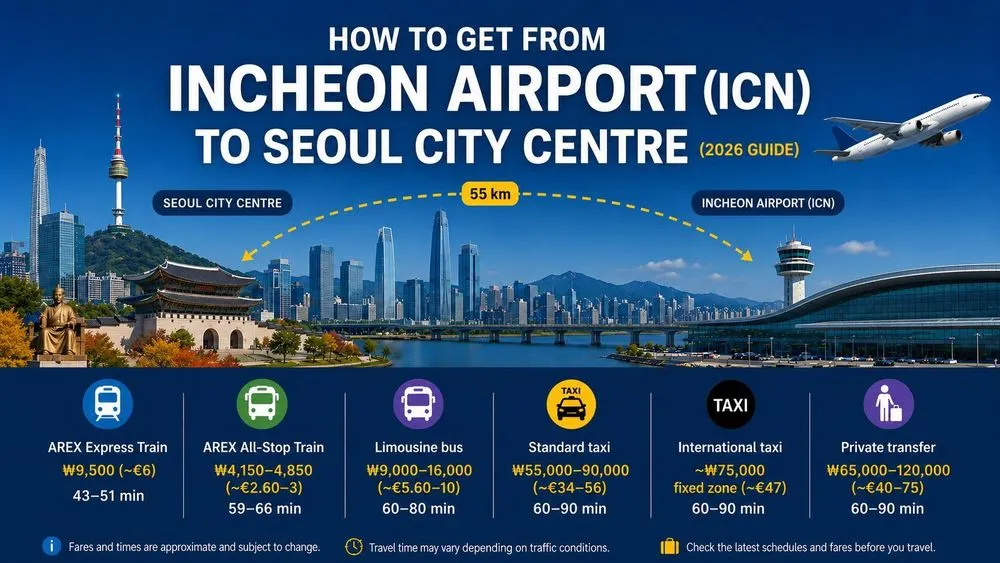
| Option | Price (one-way) | Time to Seoul Station | Hours | Best for |
|---|---|---|---|---|
| AREX Express Train | ₩9,500 (~€6) | 43–51 min | ~05:30–24:00, every 20–40 min | Speed, comfort, no stops |
| AREX All-Stop Train | ₩4,150–4,850 (~€2.60–3) | 59–66 min | ~05:20–24:00, every 5–10 min | Best value overall |
| Limousine bus | ₩9,000–16,000 (~€5.60–10) | 60–80 min | ~05:00–23:00, every 20–30 min | Direct-to-hotel drop-off |
| Standard taxi | ₩55,000–90,000 (~€34–56) | 60–90 min (traffic-dependent) | 24 hours | Groups, night arrivals |
| International taxi | 60–90 min | 24 hours | English-speaking driver | |
| Private transfer | ₩65,000–120,000 (~€40–75) | 60–90 min | Pre-booked, 24/7 | Families, zero-friction arrivals |
⚠️ First get a T-money card. Nearly everything in this guide — AREX, buses, taxis, and later the Seoul metro — works far more smoothly with a T-money card, Korea's contactless transit card. GS25 and CU convenience stores in both terminals' arrivals areas sell them. Load ₩20,000–30,000 (~€12–19) on arrival; this comfortably covers the airport transfer plus your first days of metro and bus travel in the city.
Option 1 — AREX Express Train: fastest, most comfortable, non-stop
The AREX Express Train runs non-stop from Incheon Airport directly to Seoul Station, with no intermediate stops. Journey time is 43–51 minutes depending on which terminal you depart from. The fare is a flat ₩9,500 (roughly €6) each way. Trains depart every 20–40 minutes, running from approximately 05:30 until midnight.
Both terminals have their platforms on basement level B1 — follow signs for "Airport Railroad" or "Train to Seoul" from the arrivals hall. Tickets are available at the AREX Travel Center counters in both terminals, from vending machines, or pre-booked online in advance (occasional promotional pricing, including buy-one-get-one offers, has appeared periodically through 2026 — worth checking before you fly).
Seating is reserved and comfortable, with generous luggage space — a meaningful advantage over the crowded standard commuter trains found at some other major airports. From Seoul Station, you connect directly to Seoul Metro Line 1 and Line 4, plus KTX high-speed rail if you're continuing elsewhere in Korea.
The honest take: For most first-time visitors, this is the option that requires the least thought. It's non-stop, it's comfortable, the fare is fixed regardless of traffic, and Seoul Station puts you within easy reach of most central neighbourhoods via a short metro or taxi hop. The only reason to choose the All-Stop Train instead is pure budget — the Express costs roughly ₩4,700–5,300 more for a saving of about 15–20 minutes.
Option 2 — AREX All-Stop Train: nearly as good, meaningfully cheaper
The All-Stop Train runs on the same AREX line but calls at every station along the way, including Gimpo Airport (Seoul's secondary, mostly-domestic airport) and several commuter stops before reaching Seoul Station. The fare is ₩4,150–4,850 depending on your exact origin terminal — well under half the Express fare. Journey time is 59–66 minutes, and trains run considerably more frequently — every 5–10 minutes during the operating day, from around 05:20 to midnight.
This is also the train to take if your destination is actually near Gimpo Airport, or if you're connecting onward through one of the intermediate stations rather than going all the way to Seoul Station.
The honest take: For most travellers, this is genuinely the best value option on the list. You lose about 15–20 minutes compared to the Express, in exchange for a fare that's roughly half the price — and the trains run more often, so you're rarely waiting long regardless of which one you catch first.
Option 3 — Limousine bus: direct to your hotel, no station transfer
Korea's airport limousine buses are a genuinely useful middle option: comfortable long-distance coaches that run dozens of routes across Seoul, each one serving a specific set of hotels and neighbourhoods rather than a single central station. Fares range from ₩9,000 to ₩16,000 depending on the route and whether it's a standard or deluxe service, with journey times of 60–80 minutes depending on traffic and your specific stop.
Buses depart roughly every 20–30 minutes from clearly marked stands outside both terminals, running from approximately 05:00 to 23:00. Ticket booths are located near several of the terminal exits — the volume of different routes can be a little overwhelming on a first visit, so it's worth checking the exact route number for your hotel or neighbourhood before you land (the airport's official site lists routes by destination).
A useful, lesser-known perk: families of three or more travelling together, including at least one child, are entitled to one free fare across all limousine bus routes.
The honest take: If your hotel is directly on one of the well-served limousine routes, this option saves you the extra metro or taxi leg that AREX requires from Seoul Station. The trade-off is slightly higher cost than the All-Stop Train and a genuinely confusing route map on first arrival — worth five minutes of research before you land rather than five minutes of confusion after.
Option 4 — Standard taxi: convenient but the most expensive road option
Korean taxis are metered, and the total for a ride to central Seoul typically runs ₩55,000–75,000 depending on your exact destination — Hongdae, on the western side of the city, tends to be cheaper (around ₩55,000–65,000) simply due to shorter distance, while Gangnam, further east across the river, runs higher (₩75,000–90,000) given the distance and traffic. Journey time is 60–90 minutes depending on traffic and destination.
One genuinely good piece of 2026 news: the toll for the Incheon Bridge expressway — the main route into the city — was significantly reduced to just ₩2,000, down considerably from the roughly ₩7,900 charged in previous years. This makes the realistic all-in taxi fare noticeably cheaper than it used to be.
There's also a useful quirk specific to this route: normally, a taxi crossing from one city's registration zone into another (Incheon to Seoul, in this case) attracts a 20% intercity surcharge. Because Incheon Airport is designated a special joint transport zone, this surcharge is waived for Seoul-registered taxis picking up at the airport — worth knowing if you're comparing fares or discussing the trip with your driver.
Late-night surcharges apply between roughly 22:00/midnight and 04:00, adding 20–40% to the metered fare — a ₩80,000 daytime fare to Gangnam can become ₩100,000+ after midnight. If your flight lands in this window, factor that into your budget.
Taxi ranks are clearly signed and colour-coded by type at both terminals — at Terminal 2, for example, standard "Seoul" taxis queue in a light green–marked zone around Gates 5C–6C, while deluxe, international, and jumbo/call van taxis have separate designated areas. Look for the terminal signage on arrival, as the exact gate numbers can shift.
The honest take: Most standard taxi drivers are Korean-speaking only, and pronunciation of hotel names can genuinely cause confusion — having your destination written in Korean (on your phone or a printed confirmation) saves a surprising amount of friction. For groups of three or four with luggage, the per-person cost becomes reasonable; for a solo traveller, it's a meaningful premium over the train.
Option 5 — International taxi: fixed price, guaranteed English
For an extra ~20% over the standard metered fare, international taxis at Incheon guarantee an English-speaking driver (sometimes also Japanese or Chinese) and charge a fixed, zone-based rate rather than a meter — typically around ₩75,000 to central Seoul, tolls included. These are a separate, clearly marked queue at both terminals.
The honest take: If language is a genuine concern — particularly for a first visit to Korea, arriving tired, with an address that might be hard to pronounce correctly — the fixed international taxi rate removes a layer of uncertainty for a fairly modest premium over a standard metered ride.
Option 6 — Private transfer: the zero-effort option
Pre-booked private transfers meet you in the arrivals hall with a name sign and take you directly to your address — hotel, Airbnb, wherever — at a price agreed before you land. Rates run from roughly ₩65,000 to ₩120,000 depending on vehicle size (standard sedan up to larger vans for groups), and crucially, most operators charge per vehicle rather than per person — a real advantage for groups or families, where the cost can work out cheaper per head than the train.
These services run 24 hours, which makes them a genuinely strong option for very late or very early arrivals, when other transport is thinner or subject to bigger surcharges. Some operators apply a small additional fee for pickups after roughly 21:30.
The honest take: For families, groups of three or more, or anyone landing exhausted after a long-haul flight who simply doesn't want to think about trains, tickets, or taxi queues, this is worth the modest premium. Book ahead — arranging on arrival is possible but loses the main advantage, which is having someone already waiting for you.
Which option is right for you?
- Solo or duo, want speed and don't mind paying a bit more → AREX Express. 43–51 minutes, non-stop, comfortable.
- Solo or duo, budget-conscious → AREX All-Stop. Nearly as fast, roughly half the price, and trains run more often.
- Hotel directly on a limousine bus route → Limousine bus. Saves the onward leg from Seoul Station.
- Group of three or four with luggage → Standard taxi or private transfer. Per-person cost becomes very reasonable.
- First time in Korea, worried about the language barrier → International taxi or pre-booked private transfer.
- Arriving between midnight and 04:00 → Taxi (with the night surcharge factored in) or a pre-booked private transfer. Trains and buses largely stop running in this window.
- Connecting onward to Gimpo Airport → AREX All-Stop Train, which serves Gimpo directly in about 30 minutes.
- Travelling with three or more family members including a child → Ask about the free-fare discount on limousine buses.
Things people get wrong at Incheon Airport
Not getting a T-money card before leaving the terminal. Nearly everything downstream — metro, buses, taxis, convenience stores — works better with one. They're sold at GS25 and CU stores right in the arrivals area of both terminals. Get one before you head to your transport of choice.
Assuming the Express and All-Stop trains are the same thing. They share a line but differ meaningfully in price, stops, and frequency. If you want Gimpo or an intermediate stop, you need the All-Stop; if you want the fastest ride and don't need any intermediate stop, take the Express.
Getting into the wrong taxi lane. Standard, deluxe, international, and jumbo taxis all queue in separate, colour-coded zones that can be a short walk apart. Check the terminal signage rather than just walking up to the first taxi you see.
Underestimating the late-night surcharge. A taxi that would cost ₩80,000 in the afternoon can run past ₩100,000 after midnight with the 20–40% surcharge applied. If your flight lands very late, budget for this or consider a pre-booked transfer instead, where the price is agreed in advance.
Assuming your destination pronunciation will translate. Standard taxi drivers are typically Korean-speaking only, and hotel or neighbourhood names can be genuinely difficult to communicate verbally. Have your destination written in Korean — most booking confirmations include this, or a quick translation app search works — ready to show the driver.
Withdrawing cash via the ATM's currency conversion offer. Airport ATMs will often prompt you to withdraw in your home currency for "convenience" — this uses a considerably worse exchange rate. Always choose to withdraw in Korean won.
Final thought
Incheon is one of the more genuinely pleasant airports to spend time in if you have to — there's a sleeping lounge, cultural experience spaces, and 24-hour conveniences that make even an overnight layover manageable. But for a normal arrival, Korea's transport system does the rest of the work for you: the AREX trains are fast, clean, and reasonably priced, the limousine buses reach almost anywhere in the city directly, and even the taxi system — now with a much lower bridge toll than in previous years — is more affordable than it used to be.
Get the T-money card first. Pick the train unless your group size or arrival time points somewhere else. You'll be in central Seoul, looking for your first bowl of naengmyeon, within about an hour of landing.
And if the cheap flight to Seoul is still the missing piece, check the Faretus deals page. ICN is one of the best-connected long-haul hubs from Europe, and fare drops on this route come up more often than travellers expect.
All information in this article is based on publicly available data from official transport providers as of July 2026. Prices, schedules and service arrangements may change without notice. Always verify directly with the relevant provider — AREX (arex.or.kr), Incheon International Airport (airport.kr) — before travelling. The author and Faretus bear no responsibility for any decisions made based on the content of this article.