

How to Get from Copenhagen Airport to the City Centre (2026 Guide)
22 June 2026
Disclaimer: All prices, schedules and service details in this article reflect information available in June 2026. Transport fares and timetables change regularly — always verify the latest information on the official websites of each provider before you travel. The author and Faretus accept no liability for any inaccuracies, changes, or decisions made based on this content.
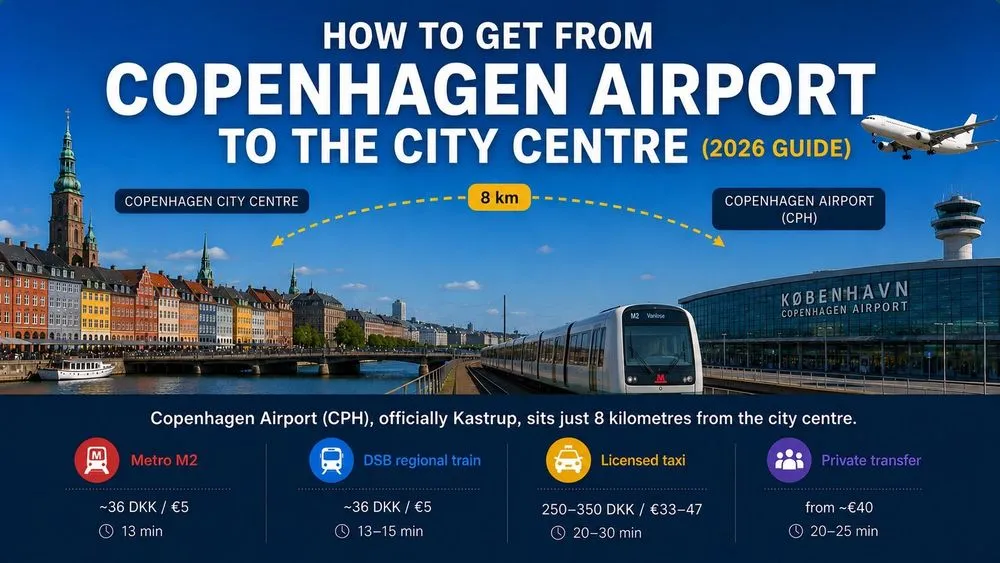
Copenhagen Airport (CPH), officially Kastrup, sits just 8 kilometres southeast of the city centre — which makes it one of the closest major airports to a European capital, and one of the easiest to arrive at without stress. The journey into the city is genuinely well designed. There is a metro and a train sharing the same underground station, they run frequently, they take 13 minutes, and they cost the same ticket. For most travellers, the decision is made before you even land.
The complication isn't finding a way in. It's knowing a few things that aren't obvious from first principles: that Uber and Bolt don't operate here the way they do everywhere else in Europe, that taxi fares are metered and vary more than you'd expect, and that the City Pass can save you meaningful money if you're staying more than a couple of days. Get those right and everything else takes care of itself.
There are four realistic ways to make the journey. All of them are below with current prices, honest timing, and a clear note on who each option suits.
The quick comparison
| Option | Price (one-way) | Time to centre | Frequency | Best for |
|---|---|---|---|---|
| Metro M2 | ~36 DKK / €5 | 13 min | Every 4–6 min (day) / 15–20 min (night) | Almost everyone |
| DSB regional train | ~36 DKK / €5 | 13–15 min | Every 10–20 min | Travellers heading to Central Station |
| Licensed taxi | 250–350 DKK / €33–47 | 20–30 min | On demand | Groups, heavy luggage, night arrivals |
| Private transfer | from ~€40 | 20–25 min | Pre-booked | Business travel, families |
Note on ride-hailing: Uber operates at CPH but functions as a metered taxi app — drivers are licensed taxi professionals, and pricing is comparable to a regular Copenhagen taxi. Bolt does not currently operate in Denmark. If you're arriving expecting a cheap Uber the way you'd find in London or Amsterdam, adjust your expectations before you land.
Option 1 — Metro M2: the obvious choice for most travellers
The M2 metro line runs directly from Copenhagen Airport to the heart of the city without any changes, stops, or connections to navigate. The metro station is a direct extension of Terminal 3 — walk out of arrivals, follow the signs upstairs, and you're there. If you land at Terminal 2, it's a short walk. Terminal 1 has a free shuttle bus to Terminal 3 taking about five minutes.
The M2 stops at Christianshavn (11 minutes, for Christianshavn and the canals), Kongens Nytorv (13 minutes, for Nyhavn, the Royal Theatre and the top of Strøget), and continues through the city. For most visitors staying in the historic centre, Kongens Nytorv is the right stop.
A single 3-zone ticket costs 36 DKK (approximately €5) and is valid for 90 minutes, covering any onward metro, bus or S-train journey within that window. Buy at the machines in the terminal arrivals area — they accept cards; notes are not accepted, and there is no ticket purchase on board. The M2 runs 24 hours a day, seven days a week: every 4–6 minutes during the day and evening, and every 15–20 minutes overnight. There is no night supplement.
If you're staying two or more days, the City Pass Small is worth buying on arrival. It covers unlimited travel across the metro, buses and trains in zones 1–4 (including the airport) for 24, 48, 72, 96 or 120 hours. The 24-hour version costs 100 DKK (about €13); the 72-hour version costs 230 DKK (about €31). Buy it in the Rejsebillet app or at the ticket machines. For a three-day visit where you're using the metro daily, it pays for itself on the second day.
The honest take: The M2 is one of the best airport metro connections in Europe — fast, frequent, clean, 24/7 and cheap. For a solo traveller or a pair with manageable luggage, there is almost no reason to take anything else. The one limitation is that it doesn't serve Copenhagen Central Station directly; for that, take the train instead.
Option 2 — DSB regional train: same price, different destination
The DSB regional train shares the underground station with the metro at Terminal 3 but runs to Copenhagen Central Station (København H) — a different destination that matters if your hotel is near the station, or if you're continuing by train to Odense, Aarhus or anywhere else in Denmark. The journey takes 13–15 minutes and the single ticket costs the same 36 DKK as the metro.
Trains run approximately every 10 minutes during the day (roughly at :24 and :44 past each hour, with additional services at peak times) and one to three times per hour at night. From Central Station you can connect to the S-train network, all long-distance DSB services, and the metro at Vesterport.
One practical note: the train platform at the airport has departures in two directions — one toward Copenhagen, one toward Malmö in Sweden. Make sure you're on Platform 2 for Copenhagen. It's clearly signed, but worth double-checking.
The honest take: If your destination is Central Station or anywhere west of it, take the train. If it's Nyhavn, Frederiksberg or the Indre By area, the metro is more direct. Both cost the same and take about the same time — it's purely a question of where you're going.
Option 3 — Licensed taxi: reliable but expensive solo, reasonable in a group
Copenhagen's taxi market is regulated, metered and reliable. You'll find the official taxi rank directly outside Terminal 2 and Terminal 3 arrivals — look for the designated stands. Major operators include Taxa 4×35, Dantaxi and Viggo (an electric-only app-based fleet with fixed quotes). All licensed taxis accept cards; tipping is not expected and is typically included in the metered fare.
A typical daytime ride to central Copenhagen costs 250–350 DKK (€33–47) and takes 20–30 minutes depending on traffic. Evening and weekend fares are higher — the base rate rises and per-km charges increase after 18:00. During peak hours on the E20 motorway, the same journey can push toward 400 DKK.
As noted above, Uber operates at CPH but prices like a regular taxi. It is not cheaper. If you prefer to book digitally, Viggo offers fixed-price quotes through its app before you commit, which removes the metering uncertainty.
The honest take: For a solo traveller, a DKK 300 taxi versus a DKK 36 metro ticket is a hard sell. For two people it's DKK 150 each — still five times the metro, but now within the range of a reasonable convenience charge. For three or four people splitting the fare, the taxi becomes competitive with individual metro tickets while delivering you door-to-door. Do the maths for your group before you queue.
Option 4 — Private transfer: for certainty and comfort
Pre-booked private transfers meet you in the arrivals hall with a name sign, track your flight, and charge a fixed price regardless of traffic or delay. Prices for a standard sedan start at around €40–55 for central Copenhagen; larger vehicles for groups or families run from €65–90.
Several reputable operators serve CPH. The electric limousine end of the market starts around €100 (Mercedes EQV, up to seven passengers) and is primarily aimed at business travellers or groups who want a guaranteed premium experience. For most visitors, a standard pre-booked sedan delivers the essentials — fixed price, driver in arrivals, no queuing — at a price that's comparable to a taxi for two people.
The honest take: The private transfer earns its price when you're arriving with young children, heavy luggage, or at an hour when you simply don't want to figure anything out. For a family of four, €50 split four ways is €12.50 per person — barely more than the metro and significantly more comfortable. For a solo business traveller on a tight schedule, it removes all variables. For a solo leisure traveller with a carry-on, the metro is objectively the better choice.
Which option is right for you?
- Solo traveller, any luggage, any time → Metro M2. Thirteen minutes to Kongens Nytorv for €5. There is no better deal.
- Staying 2+ days → Buy the City Pass at the airport. It covers the journey in and all your city transport for the duration.
- Heading to Central Station or beyond → DSB train, same ticket, same price as the metro.
- Two people travelling together → Metro is still cheapest, but a taxi at DKK 300 split two ways is DKK 150 each. Not outrageous for door-to-door if your hotel is awkward to reach from a metro stop.
- Group of three or four → Taxi or private transfer. Per-head cost becomes competitive, and nobody has to navigate metro stops with luggage.
- Family with children → Private transfer or taxi. One DKK 36 adult ticket covers two children under 12 for free on public transport — so the metro is financially reasonable for a family too, though the luggage logistics on a busy carriage are a different matter.
- Arriving after midnight → Metro. It runs 24/7 with no night surcharge, which is genuinely unusual and genuinely useful.
One thing Copenhagen gets right that most cities don't
The metro runs all night. Not a limited night service with gaps and substitution buses — all night, every 15–20 minutes, at the same price as daytime. If you're landing at 02:30, the M2 is waiting. That alone puts CPH in a different category from most European airports.
The city is also small enough that the metro connection actually gets you close to where you need to be. Copenhagen's historic centre is compact, walkable, and served by several M2 stops in rapid succession. You won't land at a peripheral terminus and then need to figure out three more connections. You get off at Kongens Nytorv and walk ten minutes to Nyhavn. That's the whole journey.
If you're flying in on a fare you found through Faretus, the metro is the logical final step — cheap, fast, and exactly what an airport transfer should be.
And if you haven't found that cheap flight yet, the Faretus deals page is where to start.
All information in this article is based on publicly available data from official transport providers as of June 2026. Prices, schedules and service arrangements may change without notice. Always verify directly with the relevant provider — DOT/Rejsebillet (dinoffentligetransport.dk), DSB (dsb.dk), Taxa 4×35 (taxa.dk), or Viggo (viggo.com) — before travelling. The author and Faretus bear no responsibility for any decisions made based on the content of this article.