

How to Get from Budapest Airport to the City Centre (2026 Guide)
19 June 2026
Disclaimer: All prices, schedules and service details in this article reflect information available in June 2026. Transport fares and timetables change regularly — always verify the latest information on the official websites of each provider before you travel. The author and Faretus accept no liability for any inaccuracies, changes, or decisions made based on this content.
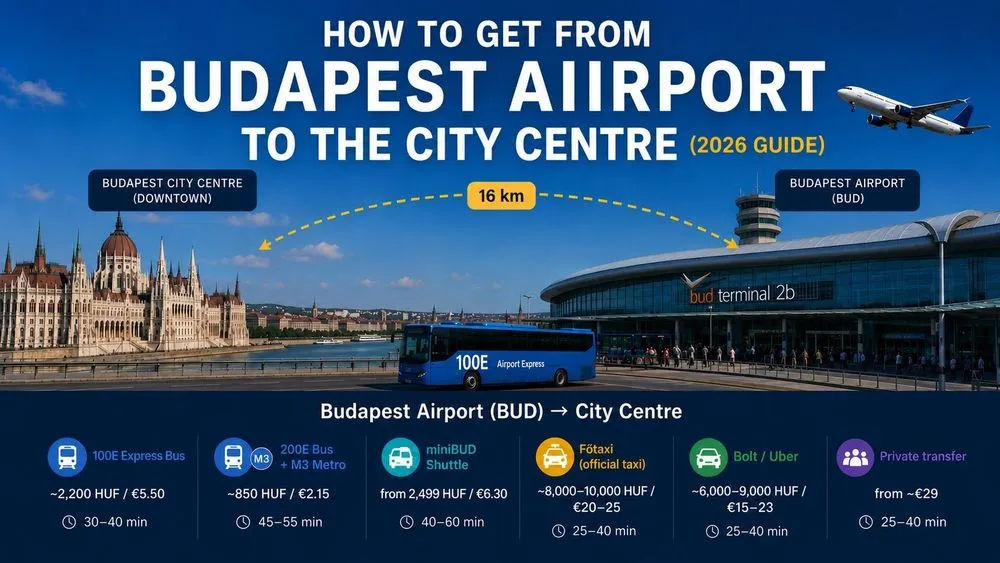
Budapest Liszt Ferenc International Airport (BUD) sits about 16 kilometres southeast of the city centre — close enough that you'll catch your first glimpse of Hungarian flatlands before the taxi even reaches the motorway, but far enough that a bad choice at arrivals will cost you real money or real time. There are a handful of unlicensed drivers near the exits who'd love to help you make that bad choice. Ignore them.
There are five realistic ways to get from BUD into central Budapest. I've laid them all out below with current prices, honest timing, and a note on who each option actually suits. No filler.
One important note before you start: the currency
Budapest runs on Hungarian Forints (HUF), not euros. Almost every transport option here is priced in forints, and at current rates roughly €1 ≈ 395 HUF. Cards are accepted almost everywhere following a 2025 regulation making card payment mandatory in all licensed taxis — but the airport currency exchange desks offer poor rates. If you need cash, use an ATM in the arrivals hall and skip the exchange counters entirely.
The quick comparison
| Option | Price (one-way) | Time to centre | Frequency | Best for |
|---|---|---|---|---|
| 100E Express Bus | ~2,200 HUF / €5.50 | 30–40 min | Every 10 min (day) | Budget travellers |
| 200E Bus + M3 Metro | ~850 HUF / €2.15 | 45–55 min | Every 10–15 min | Ultra-budget, pass holders |
| miniBUD Shuttle | from 2,499 HUF / €6.30 | 40–60 min | Every 15–30 min | Solo travellers with luggage |
| Főtaxi (official taxi) | ~8,000–10,000 HUF / €20–25 | 25–40 min | On demand | Groups, night arrivals |
| Bolt / Uber | ~6,000–9,000 HUF / €15–23 | 25–40 min | On demand | App users |
| Private transfer | from ~€29 | 25–40 min | Pre-booked | Families, business travel |
Option 1 — 100E Express Bus: the smart budget pick
The 100E is a dedicated airport express bus and the default choice for most independent travellers. It runs directly from Terminal 2 (the only active terminal at BUD) into the heart of Pest, stopping at three central points: Kálvin tér, Astoria, and Deák Ferenc tér. That last stop is where all three Budapest metro lines — M1, M2, and M3 — converge, which means once you're there you can reach virtually any neighbourhood in the city within minutes.
A single ticket costs 2,200 HUF (approximately €5.50). Critically, this is a special airport shuttle ticket — it is not covered by standard BKK travel passes or the Budapest Card. Buy it from the purple vending machines at the bus stop outside arrivals, from the BKK counter inside the terminal, or via the BudapestGO app. You can also pay by card directly on the bus. During the day the bus runs every 10 minutes; at night the frequency drops to every 30–40 minutes, but it runs 24 hours a day, seven days a week.
Journey time is 30–40 minutes in normal traffic. The bus stop is located between Terminals 2A and 2B on the arrivals level — walk out the doors, turn slightly left, and you'll see it.
The honest take: For most solo travellers arriving with manageable luggage, the 100E is the obvious answer. It's fast enough, cheap, and deposits you at the city's main transport hub. The only real downside is that it fills up on busy summer days, and dragging a large suitcase onto a crowded airport bus is never enjoyable.
Option 2 — 200E Bus + M3 Metro: the cheapest way in, period
If you're on an extremely tight budget — or if you already have a Budapest travel pass — the 200E + M3 combination is unbeatable on price. The 200E is a standard city bus that connects the airport to Kőbánya-Kispest, the southern terminus of the M3 (Blue) metro line. From there you take the metro north into the city centre, changing to M1 or M2 at Deák tér if needed.
The standard BKK single ticket costs around 450 HUF and you'll need one for the bus and a transfer ticket (around 400 HUF) for the metro — or a single travel pass that covers both. Total cost: roughly 850 HUF (under €2.20). If you already have a 24-hour or 72-hour BKK pass, this route is effectively free. The journey takes 45–55 minutes including the metro connection.
One caveat: the 200E only runs until around 23:00. Late at night it terminates at Határ út instead of Kőbánya-Kispest M, and you'll connect to night buses rather than the metro. If you're landing after midnight, this option requires more navigation.
The honest take: It's the cheapest option on this list by a significant margin. But it involves a transfer with your luggage, more stops, and the metro isn't the most pleasant experience with a large suitcase during rush hour. Worth it if you're budget-conscious and travelling light. Not worth it if you're arriving tired at 22:30.
Option 3 — miniBUD Shuttle: the comfortable middle ground
miniBUD is the official airport shuttle service of Budapest Liszt Ferenc Airport, and it occupies the space between the bus and a taxi. Prices start at 2,499 HUF (approximately €6.30) per person, and the service drops you off at your specific address in central Budapest rather than a bus stop — which, depending on where your accommodation is, can save you a meaningful amount of walking and dragging.
Shuttles are shared (other passengers may be on board heading to nearby destinations), depart every 15–30 minutes, and run 24 hours a day. You can book at the miniBUD counter in the arrivals hall or pre-book online. Journey time to your door is typically 40–60 minutes, with some variability depending on how many stops the driver makes along the way.
If you have the Budapest Card, you get a 20% discount on miniBUD fares — worth factoring in if you've already bought one for sightseeing.
The honest take: miniBUD makes most sense for solo or duo travellers who have a suitcase and don't fancy standing on a bus, but don't want to pay full taxi prices either. The door-to-door delivery is the genuine advantage. If there are three of you, the maths shifts toward a taxi.
Option 4 — Főtaxi: the regulated no-surprises option
Főtaxi is the exclusive official taxi provider at Budapest Airport. Their cars — all licensed yellow vehicles — wait at ranks directly outside the arrivals exits, and there's a Főtaxi booking booth inside the terminal if you'd prefer to queue inside.
Fares are metered, not fixed, but the regulated rates mean a ride to most central addresses costs 8,000–10,000 HUF (approximately €20–25), depending on traffic and your exact destination. There are no flat-rate airport zone tariffs the way Vienna operates, so the meter runs — though the regulated pricing means you won't be dramatically overcharged if you use an official car. Journey time is 25–40 minutes by car.
One firm rule: never accept a ride from someone who approaches you inside the terminal. These are almost always unlicensed drivers charging two or three times the going rate. Walk to the official rank outside, or use the Főtaxi booth.
Since 2025, card payment is mandatory in all licensed Budapest taxis.
The honest take: For two people sharing, the taxi works out to roughly €10–12 per head — at that point it's competitive with the express bus and you arrive door-to-door. For three or four people, it's often the best value on the list. Run the numbers before assuming the bus saves you more than a few euros per person.
Option 5 — Bolt and Uber: flexible, usually cheaper than Főtaxi
Bolt is the primary ride-hailing app in Budapest and it works well at the airport. Uber also operates — through a partnership with Főtaxi since mid-2024, so Uber will connect you to a licensed yellow taxi and charge accordingly, typically at a slightly higher rate than Bolt.
Both apps have dedicated pickup zones outside the arrivals area. During normal hours, Bolt typically quotes 6,000–9,000 HUF (€15–23) to the city centre. During peak hours, bad weather, or busy arrival windows, prices rise with demand. Bolt is generally a few hundred forints cheaper than metered Főtaxi for the same journey, and the fixed price shown upfront is a genuine advantage.
The honest take: Check Bolt when you land. If it quotes under 7,000 HUF, take it. If surge pricing has pushed it to 11,000, walk to the Főtaxi rank and pay the meter instead — you'll likely come out the same or slightly ahead, and you won't have to find the app pickup zone.
Option 6 — Private transfer: for peace of mind
Pre-booked private transfers fix the price before you land, include real-time flight tracking so the driver adjusts automatically if you're delayed, and meet you in the arrivals hall with a name sign. Prices for a sedan start at around €29–38 depending on provider.
This option makes the most practical sense for families travelling with children, business travellers who need to be somewhere specific at a specific time, or anyone arriving late at night who would rather not figure out the shuttle logistics from scratch.
The honest take: The price lands close to a metered taxi for two people, but the experience is meaningfully better — no queue at the rank, no uncertainty about surge pricing, and someone is already looking for you when you walk through the doors. Worth the small premium on a difficult travel day.
Which option is right for you?
There's no universally correct answer, but here's an honest shortcut:
- Solo, one bag, daytime arrival → 100E Express Bus. Six euros to Deák tér, and you're in the heart of the city.
- Ultra-budget with a travel pass → 200E + M3 Metro. Practically free if the pass covers it.
- Solo with luggage, don't want to stand on a bus → miniBUD Shuttle. Door-to-door for not much more than the bus ticket.
- Two or three people travelling together → Run the numbers. A Főtaxi or Bolt at €22 split two ways is €11 each — barely more than the bus, and you arrive at your hotel.
- Family with kids and luggage → Private transfer or Főtaxi. Per-head cost is reasonable in a group, and nobody has to heave suitcases onto a bus.
- Arriving after midnight → 100E bus (runs 24 hours) or a pre-booked private transfer. The 200E/metro combination gets complicated late at night.
Final thought
Budapest's airport transfer situation is straightforward once you know the rules: take the 100E if you're alone, take a taxi or Bolt if you're a group, and under no circumstances accept a ride from someone who approaches you inside the terminal. Those are the only rules you actually need.
The city itself rewards the effort of getting there without being fleeced on arrival. If you saved money on the flight — which, if you're reading this on Faretus, is quite likely — don't hand it straight back to an unlicensed driver in the arrivals hall. Take the 100E, put the difference toward a bowl of goulash somewhere good, and enjoy Budapest.
And if you haven't found that cheap flight yet, the Faretus deals page is the place to start.
All information in this article is based on publicly available data from official transport providers as of June 2026. Prices, schedules and service arrangements may change without notice. Always verify directly with the relevant provider — BKK (bkk.hu), miniBUD (bud.hu), Főtaxi (fotaxi.hu) — before travelling. The author and Faretus bear no responsibility for any decisions made based on the content of this article.