



How to Get from Berlin Brandenburg Airport to the City Centre (2026 Guide)
20 June 2026
Disclaimer: All prices, schedules and service details in this article reflect information available in June 2026. Transport fares and timetables change regularly — always verify the latest information on the official websites of each provider before you travel. The author and Faretus accept no liability for any inaccuracies, changes, or decisions made based on this content.
Berlin Brandenburg Airport (BER), officially Flughafen Berlin Brandenburg Willy Brandt, sits about 27 kilometres southeast of the city centre. It replaced the much-loved old Tegel and the patched-together Schönefeld in 2020, arriving nine years late and several billion euros over budget — a saga that became something of a national joke in Germany. Whatever you've heard about the airport's troubled construction, the result that travellers actually experience today is straightforward and works well: a modern terminal with a proper train station built directly beneath it, and one of the simplest, flattest ticket pricing systems of any airport in this guide series.
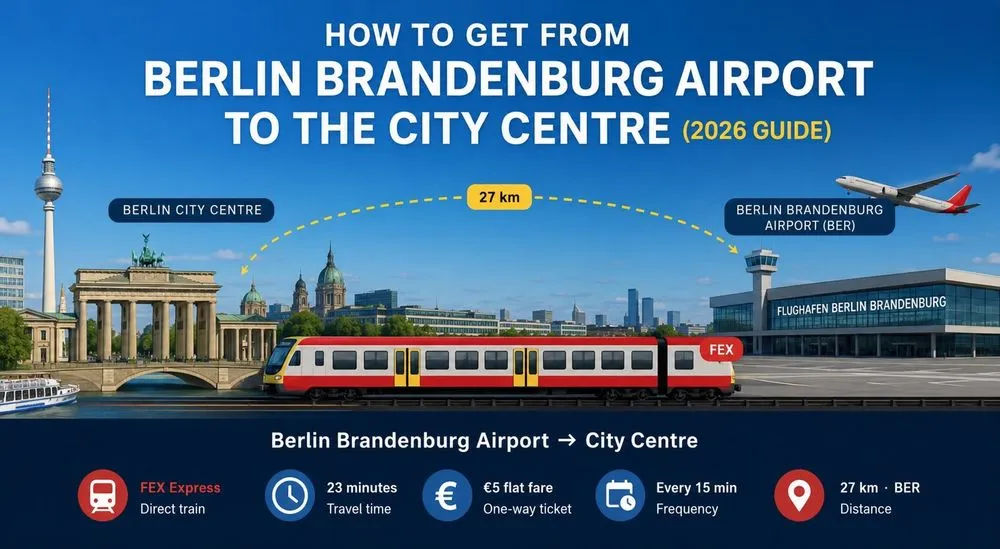
There is essentially one sentence that solves this transfer for most visitors: one train runs every 15 minutes, costs €5, and gets you to the centre in 23 minutes. If that's all you need to know, you can stop reading here. If you're staying somewhere off the main rail corridor, arriving in the small hours, or travelling as a group with heavy luggage, the rest of this guide is for you.
There are five realistic options for the journey. All of them are below.
The genuinely useful detail: Berlin's transport pricing has no zone complications for this trip
Berlin's public transport network is divided into fare zones A, B and C. BER sits in zone C, central Berlin is in zone A, and most tourist attractions fall somewhere in between — which sounds like it could get complicated, but for this specific journey it doesn't. Every public transport option from the airport to the city — the FEX express train, the regional trains, the S-Bahn — uses the same single ABC ticket, priced at €5 for an adult one-way fare as of January 2026. There's no separate airport surcharge, no special express-train premium, no need to calculate which zones you're crossing. You buy one ticket type regardless of which train you board, and it's valid for any of them.
The quick comparison
| Option | Price (one-way) | Time to centre | Frequency | Best for |
|---|---|---|---|---|
| FEX (Flughafen Express) | €5 (ABC ticket) | 23 min to Hauptbahnhof | Every 15 min, round the clock | Almost everyone |
| S-Bahn S9 | €5 (ABC ticket) | ~50 min to Hauptbahnhof | Every 20 min | Alexanderplatz, Friedrichshain, Kreuzberg |
| Regional trains (RE7/RB22/RB23) | €5 (ABC ticket) | 30–37 min | Hourly | Specific regional destinations |
| Taxi | €58–70 metered | 30–50 min | On demand | Groups of 3–4, heavy luggage |
| Uber / Bolt / FREE NOW | €45–90 (surge-dependent) | 30–50 min | On demand | Checking for a lower quote than the taxi |
| Private transfer | €55–80 | 30–45 min | Pre-booked | Early flights, late arrivals, certainty |
Option 1 — FEX (Flughafen Express): the obvious default
The FEX, universally called by its initials by both locals and the airport's own signage, is the dedicated express train connecting BER to the centre of Berlin. It departs from the station directly beneath Terminal 1 — an easy, clearly signposted walk from Terminal 2 — and runs every 15 minutes, around the clock, with four trains per hour from roughly 04:00 to 01:00.
The route stops at three points: Südkreuz (about 14 minutes), Potsdamer Platz (about 19 minutes), and Berlin Hauptbahnhof, the main central station (about 23 minutes). From any of these three, you can connect onward via U-Bahn or S-Bahn to reach most of central Berlin within another 5–15 minutes. One scheduling quirk worth knowing for 2026: until mid-June, late-night FEX services run via the Stadtbahn route through Ostkreuz and Friedrichstraße rather than the usual direct line — which is actually a convenient detail if your hotel happens to be in Friedrichshain or along that corridor, since it saves you a transfer.
The fare is the standard €5 ABC ticket, available from machines at the station, the VBB or BVG smartphone apps, or airport sales points. Validate before boarding if you have a paper ticket; app tickets are pre-validated at purchase.
The honest take: For the large majority of travellers, this is simply the right answer. It's fast, frequent enough that you're never waiting long, runs nearly 24 hours a day, and the flat €5 fare removes any temptation to overthink the ticket-buying process. Unless your hotel is specifically closer to a stop the FEX doesn't serve, there's little reason to look further.
Option 2 — S-Bahn S9: slower, but stops in more neighbourhoods
The S9 is Berlin's regular suburban rail line, and it happens to run directly through BER on its way from the airport to Spandau in the west, stopping along the way at Schöneweide, Ostkreuz, Ostbahnhof, Alexanderplatz, Friedrichstraße, Hauptbahnhof, Zoologischer Garten and Charlottenburg. The full run takes about 73 minutes, but the trip specifically to Hauptbahnhof is closer to 50 minutes — noticeably slower than the FEX, but with far more stops along the way.
Trains run every 20 minutes (every 15 minutes on Friday and Saturday nights, when Berlin's nightlife means demand stays high into the small hours). The fare is the same €5 ABC ticket as the FEX — there's no premium for taking the slower train, and no discount either.
The honest take: If you're staying in Alexanderplatz, Friedrichshain, Kreuzberg, or Prenzlauer Berg, the S9 can genuinely be the smarter choice over the FEX, because it drops you somewhere you can walk from directly, saving the transfer you'd otherwise make at Hauptbahnhof. For destinations closer to the city's geographic centre — Mitte, around the Hauptbahnhof itself, or western neighbourhoods like Charlottenburg — the FEX's speed advantage usually wins. Check your hotel's nearest S9 stop before defaulting to the express train.
Option 3 — Regional trains (RE7, RB22, RB23 and others): useful for specific destinations, not for most visitors
Several regional trains also call at BER — RE7, RB22, RB23, RB24, RB32 — each running roughly hourly and continuing onward to towns and cities across Brandenburg: Potsdam, Königs Wusterhausen, Ludwigsfelde, Rangsdorf and others. Journey time to Berlin Hauptbahnhof on these services is around 30–37 minutes, similarly priced at the standard €5 ABC ticket for journeys within the city zones.
The honest take: These trains exist primarily for regional commuters and travellers continuing on to towns outside Berlin, not as a meaningfully better way into the city centre than the FEX. The only reason to specifically seek one out is if you're heading directly to Potsdam or another Brandenburg town without wanting to change trains in Berlin first.
Option 4 — Taxi: metered, no flat rate, and reasonably predictable
Unlike several other cities in this series, Berlin does not operate a fixed flat-rate zone for airport taxis. Fares are metered, starting at a base fare of around €4.30 plus a per-kilometre rate that steps down slightly the further you travel. In practice, this works out to a fairly consistent €58–70 for the roughly 27-kilometre run to central Berlin, taking 30–50 minutes depending on traffic.
The taxi rank is on level E0, opposite Terminal 1, clearly signposted as you exit arrivals. German law requires licensed taxis to accept card payment, though not necessarily every card type — confirm with the driver before you set off if this matters to you. As with every airport in this series, ignore anyone approaching you inside the terminal offering an unofficial ride.
The honest take: For a solo traveller, paying €60+ against a €5 train ticket for the same or a longer journey time is hard to justify. The maths shifts meaningfully for groups: split four ways, a €60 taxi comes to €15 per person — actually slightly cheaper than four individual ABC tickets at €5 each plus the inconvenience of navigating with luggage. For three or four people, especially with bags, the taxi is a genuinely sound choice on both cost and comfort.
Option 5 — Uber, Bolt and FREE NOW: occasionally cheaper, often not, watch the surge
Uber, Bolt, and FREE NOW (which largely connects you with the same licensed taxi drivers, just through an app) all operate at BER, with a designated pickup zone near Terminal 1 at level E0. In principle, these apps run 10–20% below standard taxi fares, putting a typical quote somewhere in the €45–55 range during normal conditions.
In practice, surge pricing complicates that picture considerably. When several flights land within the same hour — a common occurrence at any major airport — demand spikes and prices can jump to 1.5x or 2x the baseline, with quotes occasionally reaching €90 or more during evening peak periods. There's no way to predict this in advance; it's worth checking the app the moment you clear customs rather than assuming a specific price ahead of time.
The honest take: Worth checking on arrival, particularly Bolt, which tends to offer the most competitive pricing of the three. But treat the advertised 10–20% discount over taxis as a best-case scenario, not a guarantee — during busy periods, the standard metered taxi at the rank can easily end up cheaper and faster to actually get into, since wait times for an app-summoned car can run just as long as the taxi queue during peak hours.
Option 6 — Private transfer: worth it for early flights and late arrivals
A pre-booked private transfer costs €55–80 depending on vehicle size and provider, broadly comparable to or slightly above the taxi fare, but with the driver tracking your flight and waiting in arrivals with a name sign regardless of delays. You walk out, find your name, and someone else carries the bags.
The honest take: The genuine value here is for situations where uncertainty is the real cost — a very early departure where missing a connection isn't an option, or a late-night arrival after the FEX has stopped running for the night. For a standard daytime arrival with no particular time pressure, it's a premium over the train that most solo or paired travellers won't need.
Which option is right for you?
- Solo or pair, staying near Hauptbahnhof, Mitte, or western Berlin → FEX. €5, 23 minutes, runs nearly round the clock.
- Staying in Alexanderplatz, Friedrichshain, Kreuzberg, or Prenzlauer Berg → S-Bahn S9. Slower, but it stops where you're actually going, saving a transfer.
- Continuing directly to Potsdam or another Brandenburg town → Regional train (RE7/RB22/RB23), same fare, no need to change in Berlin first.
- Group of three or four with luggage → Taxi. At this group size it can be cheaper than individual train tickets while delivering door-to-door comfort.
- Want to check for a slightly lower price than the taxi → Bolt or Uber, checked on arrival, with the understanding that surge pricing can erase the discount entirely.
- Early-morning departure or arrival between 01:00 and 04:00 → Private transfer, or a taxi if you'd rather not pre-book. FEX frequency drops sharply overnight, though Friday and Saturday nights see the S9 running every 30 minutes through the small hours.
The one sentence that actually answers this for most people
One train runs every 15 minutes, costs €5, and takes 23 minutes to the centre of Berlin. For the overwhelming majority of visitors landing at BER, that sentence is the entire decision. The airport took nine years longer than planned to open — but the transfer it eventually delivered is one of the simplest and most honestly priced in this entire guide series.
If you haven't found that flight in yet, the Faretus deals page is where to start.
All information in this article is based on publicly available data from official transport providers as of June 2026. Prices, schedules and service arrangements may change without notice. Always verify directly with the relevant provider — Berlin Brandenburg Airport (ber.berlin), VBB (vbb.de), BVG (bvg.de) — before travelling. The author and Faretus bear no responsibility for any decisions made based on the content of this article.