

How to Get from Athens Airport to the City Centre (2026 Guide)
28 June 2026
Disclaimer: All prices, schedules and service details in this article reflect information available in June 2026. Transport fares and timetables change regularly — always verify the latest information on the official websites of each provider before you travel. The author and Faretus accept no liability for any inaccuracies, changes, or decisions made based on this content.
Athens International Airport Eleftherios Venizelos (ATH) is one of the better-organised airports in southern Europe, and the transfer into the city is genuinely straightforward — once you understand one thing that trips up an embarrassing number of visitors: the metro to the airport is not covered by the standard city ticket. The airport sits in a separate fare zone. Buy the wrong ticket and you'll be turned back at the barrier with your suitcase.
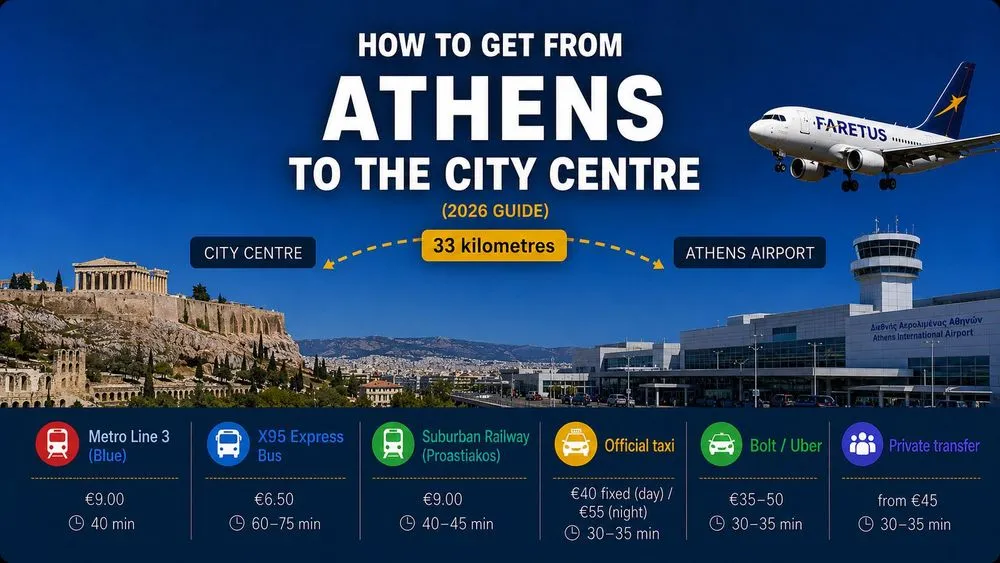
The airport is about 33 kilometres east of the city centre in an area called Spata. In good traffic, a taxi covers that distance in 30–35 minutes. The metro takes 40 minutes and doesn't care about traffic. The bus takes 60 minutes but runs all night. Here's how each option actually works.
The quick comparison
| Option | Price (one-way) | Time to centre | Hours | Best for |
|---|---|---|---|---|
| Metro Line 3 (Blue) | €9.00 | 40 min | 06:30–23:30 | Most travellers |
| X95 Express Bus | €6.50 | 60–75 min | 24 hours | Night arrivals, budget |
| Suburban Railway (Proastiakos) | €9.00 | 40–45 min | 04:30–23:00 | Piraeus / onward rail |
| Official taxi | €40 fixed (day) / €55 (night) | 30–35 min | 24 hours | Groups, families |
| Bolt / Uber | €35–50 | 30–35 min | 24 hours | App users |
| Private transfer | from €45 | 30–35 min | Pre-booked | Families, business travel |
⚠️ The airport metro ticket (€9) is completely separate from the standard city ticket (€1.20). Your city travel card, day pass, or 5-day pass will not work on the airport section of Line 3. Buy a dedicated airport ticket at the machine before you board. If you have a 3-day Tourist Pass (€20), that does cover the airport — one of the few passes that does.
Option 1 — Metro Line 3 (Blue Line): fast, direct and the obvious choice
Metro Line 3 is the backbone of the airport connection. The station is directly attached to the terminal — follow the "Metro / Train" signs from arrivals and you're on the platform in a few minutes. Direct trains run to Syntagma Square in 40 minutes, with one further stop at Monastiraki — both are in the absolute heart of Athens, a short walk from the Acropolis, the historic centre, and most tourist accommodation.
A one-way airport ticket costs €9.00 for adults. A return is €16.00, valid for 30 days — worth buying immediately if you know you'll be flying back from ATH. The reduced fare for children aged 7–12, students with a valid ISIC card, and over-65s is €4.50 each way. Children under 6 travel free.
Trains run daily from approximately 06:30 to 23:30, every 30 minutes. New for 2026: on Saturday nights, Line 3 now runs 24 hours — useful if you're arriving on a late Saturday flight.
The ticket machines at the airport station accept cash and card and have English menus. Select "Airport Ticket" and not the standard single-journey option — that's the one that gets people stuck at the gate.
The honest take: For a solo traveller or a couple with manageable luggage, the metro is the right answer almost every time. Forty minutes, a fixed price, no traffic variables, dropped directly at Syntagma. The only reason to choose something else is if you're travelling in a group (where a taxi becomes competitive), arriving after midnight (when the metro doesn't run), or your hotel is somewhere the metro doesn't conveniently reach.
Option 2 — X95 Express Bus: slower but runs all night
The X95 Express Bus connects the airport directly to Syntagma Square and is the go-to option for late-night arrivals when the metro isn't running. A single ticket costs €6.50 and the bus operates 24 hours a day, 7 days a week. Frequency is every 20–30 minutes during the day and every 40–60 minutes through the night.
Journey time is 60–75 minutes in normal traffic, and noticeably longer during rush hour — the X95 travels on the Attiki Odos toll road but still encounters city traffic once it enters Athens. For a 3am arrival with nobody else on the road, 50 minutes is realistic. For a 17:30 arrival on a weekday, budget 80 minutes.
The X95 stop at the airport is directly outside the arrivals exit. Tickets are purchased from the machines at the stop or from the driver. A standard city ticket (€1.20) does not cover the X95 — the airport express buses have their own separate fare.
There is also an X96 bus that connects the airport to Piraeus Port via the coastal road. Journey time is 60–90 minutes. It's the most practical public transport option if you're catching a ferry to the islands, though a taxi is considerably faster with luggage.
The honest take: The X95 is for two situations: you're arriving after midnight when the metro has stopped, or you're on a tight budget and have the time. For a daytime arrival with any time sensitivity, the metro is faster and no more complicated.
Option 3 — Suburban Railway (Proastiakos): useful for specific destinations
The Proastiakos suburban railway shares the same station as the metro at the airport but operates as a separate network. The fare is also €9.00 to the city centre. Its main advantage over the metro is that it serves different destinations — most usefully Larissis Station (Athens' main intercity rail hub), from where you can connect to national rail services to Thessaloniki, Patras, and other cities.
The Proastiakos also connects to Piraeus Port, making it an option for island ferry connections, though the X96 bus is often more direct.
Operating hours are approximately 04:30 to 23:00, earlier than the metro opens and later than you might expect — useful for very early morning departures.
The honest take: Unless you're connecting to a train from Larissis or specifically need to reach Piraeus, the metro is simpler for city centre travel. The Proastiakos is a good option to know about if your trip involves onward rail travel within Greece.
Option 4 — Official taxi: fixed fare, no meter, no negotiation
Athens airport taxis operate on a legally mandated fixed tariff — no meter, no negotiation, fixed by law. The fare from ATH to any address within the Athens city limits is €40 during the day (05:00–24:00) and €55 at night (24:00–05:00). These rates are posted by law inside every licensed taxi, and the driver is required to use them.
This is important: do not let the driver start the meter. The fixed tariff is the legal rate for airport transfers. If a driver insists on using the meter, or quotes you a different price, do not take the ride. The official taxi rank is outside the arrivals exit — there is a dispatcher during busy periods.
Bolt and Uber also operate at ATH and typically quote €35–50 to the city centre. Both apps show the price before you confirm. Bolt tends to be slightly cheaper. Pickup is from the designated rideshare zone — the app will direct you.
The honest take: For two people, €40 split two ways is €20 each — more than the metro but faster and door-to-door. For three or four people, it's the best value per head on this list. At night, the €55 flat rate is worth it for the convenience and speed versus an hour on the X95.
Option 5 — Private transfer: for stress-free arrivals
Pre-booked private transfers meet you in the arrivals hall with a name sign, track your flight for delays, and take you to your destination at a fixed price. Sedans to central Athens typically start at €45–55 depending on provider. For the distance involved — 33 kilometres on the Attiki Odos — private transfers are more competitive here than at more central airports.
The honest take: If you're travelling with young children, significant luggage, or simply want to close your eyes after a long flight and not think about anything, this is the option. The metro is excellent but involves escalators, luggage racks, and a transfer at Monastiraki for some destinations. A private transfer doesn't.
Which option is right for you?
- Solo or couple, arriving in daylight hours → Metro Line 3, no question. €9, 40 minutes, Syntagma.
- Arriving after midnight → X95 bus (€6.50, runs 24/7) or pre-booked transfer. The metro stops at 23:30.
- Group of three or four → Fixed-rate taxi (€40 flat, split it) or Bolt. Cheaper per head than four metro tickets.
- Family with children and luggage → Private transfer or taxi. Dragging suitcases through the metro at Doukissis Plakentias is not a good way to start a holiday.
- Catching a ferry from Piraeus → X96 bus or Proastiakos railway. Both connect directly.
- Connecting to a train at Larissis Station → Proastiakos suburban railway. Direct connection.
- Arriving Saturday night after 23:30 → Metro runs 24 hours on Saturday nights in 2026 — use it.
Things people get wrong at Athens Airport
Buying the wrong metro ticket. This is the most common mistake. The standard €1.20 city ticket and the €4.10 day pass are not valid on the airport section of Line 3. You must buy a dedicated airport ticket (€9 single or €16 return) or use a 3-day Tourist Pass (€20). The barrier will reject standard tickets — don't learn this after you've already joined a long queue.
Accepting a metered taxi. The fixed tariff for airport transfers is €40 (day) / €55 (night). If the driver starts the meter or quotes a different price, the fare will almost certainly be higher. The fixed rate is the legal one. Insist on it, or use Bolt instead.
Confusing the metro and the suburban railway. They share the same underground station at the airport. The metro (Line 3) is faster to the city centre; the Proastiakos is more useful for Piraeus or Larissis. Check the signage before you board.
Underestimating the X95 journey time. It's marked as 60 minutes on many sites. In reality, during peak hours it can run to 80–90 minutes. If you have a meeting, a ferry to catch, or a connection to make, either take the metro or take a taxi.
Pickpockets on the airport metro. Athens is generally safe, but the airport Line 3 is a known target for professional pickpockets who specifically work tourist routes. Keep your bag in front of you and your phone in a pocket rather than your hand for the duration of the journey.
A note on the Tourist Pass
If you're spending a few days in Athens, the 3-day Tourist Pass at €20 is worth knowing about. It covers unlimited journeys on the metro, buses, tram, and trolleybuses — and, uniquely among passes, also covers one trip on the airport line in each direction. If you're planning to use public transport regularly during your stay, this is the only pass that gives you the airport transfer included. Available at the airport metro station and main stations in the city.
Final thought
Athens rewards visitors who do a small amount of planning before they land, and the airport transfer is the first test of that. The metro is excellent — modern, clean, clearly signed in English, and deposits you in the middle of one of Europe's most extraordinary cities. The one thing to get right is the ticket. Everything else takes care of itself.
Buy the airport metro ticket (€9), not the city one (€1.20). Board at the airport station. Get off at Syntagma. Walk out and look right — the Acropolis is in that direction.
And if you haven't found your cheap flight to Athens yet, the Faretus deals page is a good place to start. ATH sees strong seasonal competition between carriers, and prices to Greece fluctuate more than most European routes.
All information in this article is based on publicly available data from official transport providers as of June 2026. Prices, schedules and service arrangements may change without notice. Always verify directly with the relevant provider — OASA Athens Metro (ametro.gr), Athens Airport (aia.gr) — before travelling. The author and Faretus bear no responsibility for any decisions made based on the content of this article.